Nov
Exosomes are the new buzzword in beauty science. In the last few years, every major cosmetic company has seen it as their duty to launch an anti-ageing product with exosomes. However, in the vast majority of the information materials of these companies, exosomes act as a kind of “philosopher’s stone”.
Here we have added some magic “exosomes” to our product and now they will magically cure all diseases, grant eternal life and turn lead into gold
But what exactly exosomes are, where they come from, what they contain and, most importantly, why they work so effectively is a mystery shrouded in darkness.
In this article we will tell you from a scientific point of view, with facts and evidence, what exosomes are and how exactly they help to preserve your beauty and youth.
Meamo Labs has decided to go a different way. All our products have a scientific basis and their efficacy has been confirmed by clinical studies and trials. Our new MEAMO Labs Jeunetique Exo Exosome dermal filler with exosomes is no exception.
At the same time, we realize that only specialists read serious scientific publications and there is almost no information about exosomes for the general public. Therefore, our scientific team decided to create the most comprehensive material on the use of exosomes in cosmetics. This is probably the first article on this complex and very interesting topic, intended for those who are not specialists in medicine and molecular biology (except for one section).
What are exosomes?
They are the tiny nanoscale vesicles that many cells release into the extracellular space. These vesicles were first discovered in sheep in 1983. Since then, many types of extracellular vesicles have been discovered. They turned out to have different origins and different functions. But the easiest way to categorize them was to divide them into three main groups:
-
- exosomes proper, which are between 30 and 200 nm in size,
- microvesicles (200-1000 nm),
- and apoptotic bodies (>1000 nm).
Of these three groups, only the smallest vesicles – exosomes – have been seriously used in cosmetology.
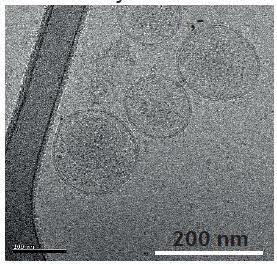
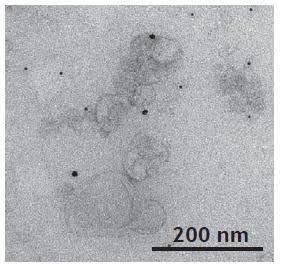
Further studies have shown that virtually all cell types secrete exosomes. In humans, they have been found in plasma and serum, urine, semen, saliva, bronchial fluid, cerebrospinal fluid, breast milk, amniotic fluid, synovial fluid, tears, lymph, bile, and even stomach acid.
In addition, it has become clear that exosomes are produced by all living organisms on our planet, from bacteria to plants and mammals.
Why do we need exosomes?
Initially, scientists thought of exosomes as a kind of “garbage bag”. It was thought that the cell simply puts all sorts of residues from biochemical reactions into this vesicle. And when the exosome fills up, the cell throws it out, beyond its membrane, and gets rid of unnecessary material.
But then it became clear that exosomes are the most important tool of intercellular communication. It’s a universal mechanism that coordinates the work of cells, allowing them to act as a single tissue in the interests of the whole organism. For example, exosomes have been found to be able to:
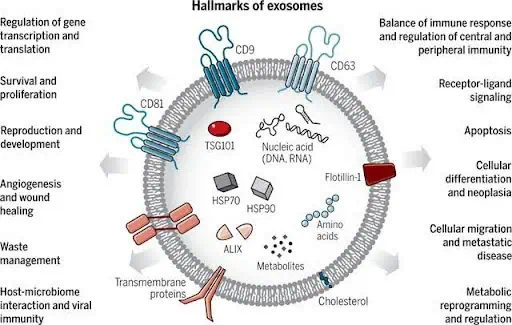
- Stimulate immune activity, accelerating the immune response to infection.
- Improve nervous system function by promoting myelin formation, neuronal survival and the formation of connections between neurons.
- Accelerate tissue repair and regeneration by increasing cell proliferation and maturation. Slow down aging through paracrine effects.
- Influence reproductive function by participating in germ cell maturation, fertilization and embryo implantation.
- Influence the success of pregnancy by playing a role in maternal-fetal immunologic communication, etc.
What do exosomes contain?
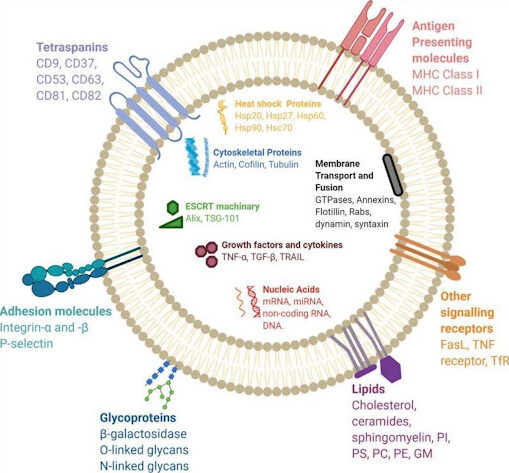
An exosome is a vesicle with a wall made of the same bilayer of phospholipids that make up normal cell membranes. This is why exosomes can easily penetrate target cells – their membrane simply fuses with the cell membrane. The exosome membrane is permeated with a large number of large signaling and adhesive molecules, mostly of a protein nature.
And inside the vesicle is a cargo of dozens of different bioactive components:
- Proteins – cytokines, ribosomal proteins, growth factors, metabolic enzymes.
- Lipids – cholesterol, ceramides and other lipid fractions.
- Nucleic acids – DNA, mRNA and microRNA (miRNA), etc.
How are exosomes formed?
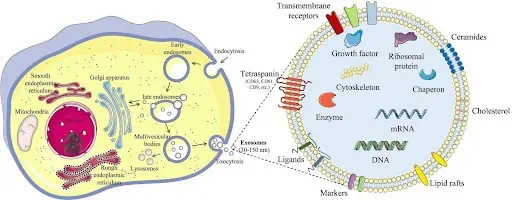
The biogenesis of exosomes begins with the folding of a portion of the cell membrane inside the cell. This leads to the formation of a large endosome (intracellular vesicle). The endosome is then saturated with bioactive content derived from the cytoplasm of the cell and its Golgi apparatus. Next, even smaller vesicles with a diameter of 30-200 nm - future exosomes - are formed inside the endosome from its membrane. The endosome then fuses with the cell membrane, releasing the exosomes to the outside.
At this stage, it is possible to isolate exosomes from the extracellular environment, purify them and place them in a high-tech cosmetic product. This makes it possible to deliver them as part of this product to the desired area of the skin. And there, as they should, the exosomes will independently move to the target cells (e.g. fibroblasts) and deliver to them the whole “cocktail” of biochemical stimulants.
Why have exosomes become popular in cosmetology and anti-aging therapy?
Exosomes have the unique ability to modulate cellular functions. At the same time, they are one of the few universal “biochemical regulators” that we can control to some extent.
Two properties of exosomes are most commonly used today in cosmetology and anti-aging therapies:
- The ability to accelerate skin recovery from a wide range of damage.
- The ability to inhibit the manifestations of skin aging (e.g. wrinkle formation, moisture loss, etc.).
Advances in molecular biology and medicine have led to an explosion of exosome research. Today, scientific databases contain nearly 20,000 articles on this topic, more than 85% of which were published within the last few years. Many of these papers focus on the use of exosomes in beauty science. We have listed some of them in the table below:
Exosomes for treatment and skin repair
- Qian L., Pi L., Fang B.R., Meng X.X. Adipose mesenchymal stem cell-derived exosomes accelerate skin wound healing via the lncRNA H19/miR-19b/SOX9 axis. Lab. Invest. 2021;101(9):1254–1266.
- Cao G., Chen B., Zhang X., Chen H. Human adipose-derived mesenchymal stem cells-derived exosomal microRNA-19b promotes the healing of skin wounds through modulation of the CCL1/TGF-β signaling Axis. Clin. Cosmet. Invest. Dermatol. 2020;13:957–971.
- Shen K., Wang X.J., Liu K.T., Li S.H., Li J., Zhang J.X., Wang H.T., Hu D.H. [Effects of exosomes from human adipose-derived mesenchymal stem cells on inflammatory response of mouse RAW264.7 cells and wound healing of full-thickness skin defects in mice] Zhonghua Shaoshang Zazhi. 2022;38(3):215–226.
- Wgealla M.M.A.M., Liang H., Chen R., Xie Y., Li F., Qin M., Zhang X. Amniotic fluid derived stem cells promote skin regeneration and alleviate scar formation through exosomal miRNA-146a-5p via targeting CXCR4. J. Cosmet. Dermatol. 2022;21(10):5026–5036.
- Xiu C., Zheng H., Jiang M., Li J., Zhou Y., Mu L., Liu W. MSCs-derived miR-150-5p-expressing exosomes promote skin wound healing by activating PI3K/AKT pathway through PTEN. Int J Stem Cells. 2022;15(4):359–371.
- Zha J., Pan Y., Liu X., Zhu H., Liu Y., Zeng W. Exosomes from hypoxia-pretreated adipose-derived stem cells attenuate ultraviolet light-induced skin injury via delivery of circ-Ash1l. Photodermatol. Photoimmunol. Photomed. 2022;39(2):107–115.
- Duan M., Zhang Y., Zhang H., Meng Y., Qian M., Zhang G. Epidermal stem cell-derived exosomes promote skin regeneration by downregulating transforming growth factor-β1 in wound healing. Stem Cell Res. Ther. 2020;11(1):452.
- Bakhtyar N., Jeschke M.G., Herer E., Sheikholeslam M., Amini-Nik S. Exosomes from acellular Wharton’s jelly of the human umbilical cord promotes skin wound healing. Stem Cell Res. Ther. 2018;9(1):193.
Exosomes as an anti-aging tool
- Liang J.X., Liao X., Li S.H., Jiang X., Li Z.H., Wu Y.D., Xiao L.L., Xie G.H., Song J.X., Liu H.W. Antiaging properties of exosomes from adipose-derived mesenchymal stem cells in photoaged rat skin. BioMed Res. Int. 2020;2020
- Rosmarwati E., Ellistasari E.Y., Kusumawardani A., Julianto I., Widhiati S., Setyawan N.A., Yanuar F. Human platelet lysate-derived exosomes are superior to the lysate at increasing collagen deposition in a rat model of intrinsic aging. J. Appl. Pharmaceut. Sci. 2023:211–216.
- Ge X., Lu L., Bai W., Wang M., Han C., Du H., Wang N., Gao M., Li D., Dong F. The novel roles of bovine milk-derived exosomes on skin anti-aging. bioRxiv. 2023 doi: 10.1111/jocd.16112. 2023.03. 23.532505.
- Han G., Kim H., Kim D.E., Ahn Y., Kim J., Jang Y.J., Kim K., Yang Y., Kim S.H. The potential of bovine colostrum-derived exosomes to repair aged and damaged skin cells. Pharmaceutics. 2022;14(2)
- Lee Y., Jeong D.-Y., Jeun Y.C., Choe H., Yang S. Preventive and ameliorative effects of potato exosomes on UVB-induced photodamage in keratinocyte HaCaT cells. Mol. Med. Rep. 2023;28(3):1–10.
- Jo C.S., Myung C.H., Yoon Y.C., Ahn B.H., Min J.W., Seo W.S., Lee D.H., Kang H.C., Heo Y.H., Choi H., Hong I.K., Hwang J.S. The effect of. Curr. Issues Mol. Biol. 2022;44(2):526–540.
- Trentini M., Zanolla I., Zanotti F., Tiengo E., Licastro D., Dal Monego S., Lovatti L., Zavan B. Apple derived exosomes improve collagen type I production and decrease MMPs during aging of the skin through downregulation of the NF-κB pathway as mode of action. Cells. 2022;11(24)
- Yan T., Huang L., Yan Y., Zhong Y., Xie H., Wang X. Bone marrow mesenchymal stem cell-derived exosome miR-29b-3p alleviates UV irradiation-induced photoaging in skin fibroblast. Photodermatol. Photoimmunol. Photomed. 2022;39(3):235–245.
- Hu S., Li Z., Cores J., Huang K., Su T., Dinh P.U., Cheng K. Needle-free injection of exosomes derived from human dermal fibroblast spheroids ameliorates skin photoaging. ACS Nano. 2019;13(10):11273–11282.
- Oh M., Lee J., Kim Y.J., Rhee W.J., Park J.H. Exosomes derived from human induced pluripotent stem cells ameliorate the aging of skin fibroblasts. Int. J. Mol. Sci. 2018;19(6)
How do exosomes interact with skin cells?
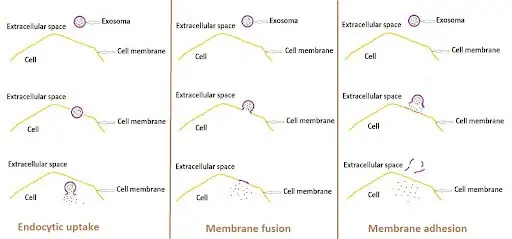
The main advantages of exosomes are their exceptional stability, high biocompatibility, and minimal immunogenicity. This allows them to function as highly efficient targeting transport. Exosomes can deliver their contents to recipient cells in three ways:
- They can enter cells by endocytic uptake.
- They can fuse directly with the cell membrane.
- They can release their “cargo” onto the cell surface, which then takes up these molecules.